

When people talk about structured cabling in Dubai, it’s easy to get lost in technical jargon. But the core idea is simple: it’s not just about running wires. It’s about building an organized, high-performance digital nervous system for your entire company.
This systematic approach is what guarantees dependable performance for everything from your phone systems to your cloud-based data.
Your Business Is Only as Strong as Its Digital Foundation
Think of your business as a high-performance supercar. It might have a powerful engine and a sleek design, but what happens if the wiring under the hood is a tangled, chaotic mess? Performance would nosedive, and finding a simple fault would turn into a costly, time-consuming nightmare.
That’s exactly what happens when your network relies on messy, point-to-point wiring. Structured cabling is the professionally engineered framework that prevents this chaos. It’s the system that makes sure your computers, VoIP phones, security cameras, and Wi-Fi access points can all talk to each other without a hitch.
Picture the difference between a traffic jam on Sheikh Zayed Road at 6 PM and the seamless, predictable flow of the Dubai Metro. One is a recipe for frustration and delays; the other is built from the ground up for speed, reliability, and future growth.
A Framework for Future Success
Treating your cabling as a strategic investment is one of the smartest moves you can make. It’s the bedrock that supports your daily operations and your ability to adopt the technologies of tomorrow. Without a solid foundation, your capacity to adapt and scale is seriously compromised.
A professionally installed cabling infrastructure is essential for:
- Smooth Daily Operations: Giving your team consistent, reliable access to email, shared drives, and communication tools without annoying lag or unexpected downtime.
- Future-Proofing Your Office: Getting your business ready for the demands of IoT devices, advanced cloud applications, and the high-speed Wi-Fi that’s now standard in Dubai’s competitive environment.
- Effortless Scalability: Making it simple to add a new employee, connect more devices, or even expand to another office floor without a massive network overhaul.
A well-designed structured cabling system isn’t just an IT expense; it’s a long-term business asset that directly fuels your operational efficiency and resilience.
Before we go further, it’s helpful to see a direct comparison. Many businesses start with an unorganized approach, but the limitations become clear very quickly.
Unorganized vs. Structured Cabling: A Quick Comparison
This table starkly contrasts the reality of a “cable spaghetti” setup with the benefits of a professionally planned system.
| Feature | Unorganized Cabling (‘Cable Spaghetti’) | Structured Cabling System |
|---|---|---|
| Performance | Unpredictable speeds, frequent bottlenecks, and high signal interference. | Consistent, high-speed performance with minimal data loss. |
| Troubleshooting | Extremely difficult and time-consuming. Tracing a single cable can take hours. | Simple and fast. Issues are isolated quickly due to organized labeling and patching. |
| Scalability | Very limited. Adding new devices or users often requires a complete re-wire. | Highly scalable. New connections can be added easily at the patch panel. |
| Maintenance | Messy and inefficient. High risk of accidental disconnections during changes. | Clean, organized, and safe. Changes are straightforward and pose little risk to the network. |
| Aesthetics | Unprofessional and hazardous, with messy cable closets and tangled wires under desks. | Clean and professional appearance, improving safety and workplace organization. |
As you can see, the choice impacts far more than just looks—it defines your network’s reliability and your ability to grow.
The market certainly reflects this. The demand for professional structured cabling in the UAE is booming, driven by new data centers and smart building projects. The market was valued at around US$ 315.3 million and is projected to climb at a CAGR of 6%, hitting nearly US$ 549.1 million by 2033. This growth is a direct result of digital transformation initiatives and government investments in smart city infrastructure. You can explore more about these market trends and what they mean for businesses like yours.
Ultimately, investing in professional structured cabling in Dubai is about setting your business up for long-term success. It delivers the speed you need right now and the flexibility you’ll need to embrace whatever comes next.
The Six Core Components of Structured Cabling
To really get a grip on professional structured cabling in Dubai, it helps to think of it as more than just a tangle of wires. A better analogy is to picture it as your building’s internal postal system, expertly designed to sort, move, and deliver data where it needs to go, every single time. Each piece has a specific job, but they all work together in a logical flow to make sure every packet of information gets to its destination without a hitch.
This entire system is built from six core, standardized subsystems. When you break it down like this, you can see how a seemingly complex network is actually a simple, well-organized, and manageable whole.
This infographic shows how these six elements create a clear hierarchy, building connectivity from the main service entry point all the way to every desk in a modern Dubai office.
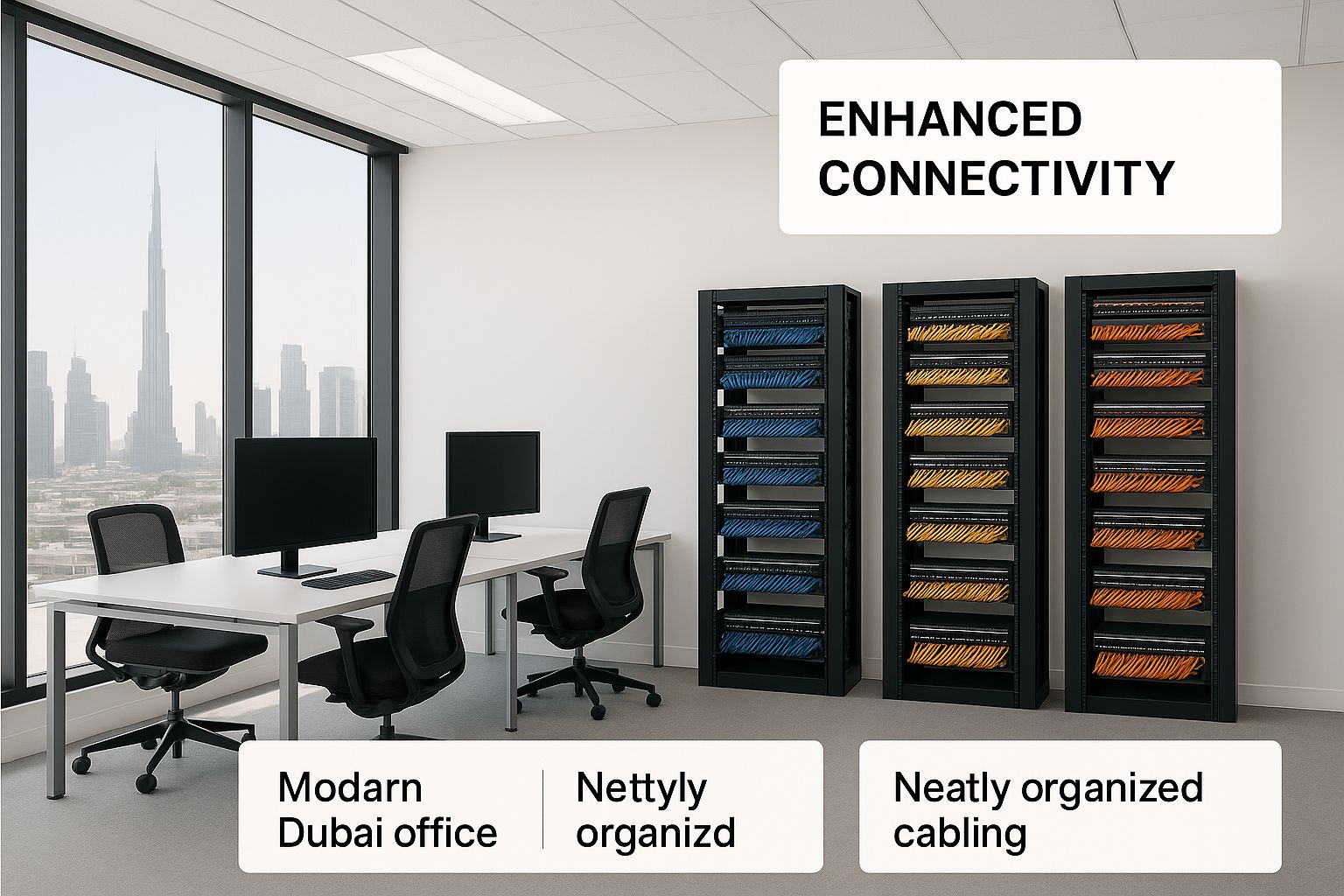
As the visual shows, a well-organized system isn’t just about looking tidy; it’s about creating a logical path for data to follow.
1. The Entrance Facility
The Entrance Facility (EF) is where it all begins. It’s the secure, dedicated space where the outside world’s network—delivered by your service provider like du or Etisalat by e&—officially connects to your building’s private network.
This is where you’ll find the demarcation point, or “demarc.” It’s the physical line in the sand that separates your responsibility from the service provider’s. The EF houses their equipment and the primary connection hardware that feeds into your internal system. In our analogy, this is the mailroom where all incoming data from the outside world first arrives.
2. The Equipment Room
Once data enters the building, it’s immediately sent to the Equipment Room (ER). This is the absolute nerve center of your entire network, a central hub that contains your most critical hardware.
Here, you’ll find the core switches, routers, servers, and your main phone system hardware (PABX). The Equipment Room is a climate-controlled, secure area built to protect this expensive and sensitive gear. Think of it as the main sorting facility in our postal analogy, where all major data packets are processed and directed to the right floor or department.
A properly designed Equipment Room is crucial for network reliability. Proper ventilation, power management, and physical security here prevent widespread outages that could cripple an entire organization.
3. Backbone Cabling
Next up, the data needs to get around the building. That’s the job of the backbone cabling, sometimes called vertical cabling. These are the high-capacity “data superhighways” that connect your main Equipment Room to other floors or different wings of the building.
Typically, backbone cabling is made of high-speed fiber optic cables or large, bundled copper cables. Why? Because it has to handle the combined traffic from hundreds, or even thousands, of individual devices. It’s the fleet of large trucks carrying mail from the central sorting facility to regional post offices.
4. The Telecommunications Room
Every floor or major section of an office will have its own Telecommunications Room (TR) or a smaller Telecommunications Enclosure (TE). This is the “regional post office” from our analogy.
The backbone cabling from the Equipment Room terminates here, connecting to distribution hardware like floor-level switches. This room serves a specific zone, taking the high-speed data from the backbone and getting it ready for delivery to individual workstations in that area.
5. Horizontal Cabling
From the Telecommunications Room, the network branches out to user areas via horizontal cabling. These are the individual cables that run from the TR, usually through ceilings or under floors, to the wall plates and outlets near each desk.
The vast majority of cabling in any installation is horizontal cabling. This is the final leg of the delivery journey, like the local postman carrying letters from the regional office directly to each house on their route. To ensure signal quality, industry standards dictate a maximum length of 90 meters for these cable runs.
6. The Work Area
Finally, we arrive at the Work Area (WA), which is exactly where the end-user connects to the network. This final subsystem includes everything from the wall outlet itself to the patch cord you use to plug in your computer, VoIP phone, or office printer.
The WA is the interface where people and their devices actually use the network. It’s the letterbox on your front door—the final destination where data is received and put to good use. A well-planned system ensures these connection points are conveniently located, clearly labeled, and ready for whatever device you need to plug in.
Navigating Dubai Cabling Standards and Regulations
When you’re installing a new network in Dubai, you’re not just plugging in a few cables. It’s a precise engineering task, guided by a strict set of rules. Following these standards isn’t just a good idea—it’s the only way to ensure your network is safe, performs at its peak, and is fully compliant with local laws.
Think of it like building a skyscraper in Downtown Dubai. You wouldn’t just show up with a crew and start digging. You’d follow a meticulous architectural blueprint and adhere to rigid municipal building codes. Structured cabling is no different; it uses internationally recognized standards as its blueprint.
The Global Blueprint: TIA/EIA Standards
The bedrock of any modern network cabling system comes from the Telecommunications Industry Association (TIA) and the Electronic Industries Alliance (EIA). These organizations are the ones who write the detailed rulebook that manufacturers and professional installers live by.
For any business, the most important part of this rulebook is how it defines the performance of different copper and fiber optic cables. Getting to know these categories is the first step in choosing the right materials for your office.
- Category 6 (Cat 6): This is the trusty workhorse of business networks and has been for years. Cat 6 easily handles data speeds up to 1 Gigabit per second (Gbps), making it more than enough for everyday office tasks, VoIP phones, and most IP security cameras. It’s a solid, cost-effective choice for businesses with standard networking needs.
- Category 6A (Cat 6A): The “A” here stands for “Augmented,” and it’s a serious upgrade. This cable supports blazing-fast speeds of 10 Gbps over the full 100-meter channel length. Its superior design offers much better protection against signal interference (crosstalk), making it the go-to for high-performance networks, data centers, and any business looking to future-proof its infrastructure.
- Fiber Optic Cabling: When you absolutely need top-tier speed and distance, nothing beats fiber. Instead of pushing electrical signals through copper wires, fiber optics use tiny pulses of light shot through hair-thin glass strands. This technology delivers enormous bandwidth, is completely immune to electrical interference, and can transmit data for miles, making it indispensable for connecting buildings or different floors in a large office tower.
Picking the right cable is a strategic move. Cat 6 might handle what you need today, but investing in Cat 6A gives you the breathing room to adopt next-generation technologies without having to rip and replace your entire cabling backbone later on.
Dubai-Specific Compliance Requirements
While global standards provide the technical game plan, Dubai’s local authorities add another critical layer of rules. Any structured cabling Dubai installation must meet these local regulations to pass inspection and be considered legal. Cutting corners here can lead to frustrating project delays, fines, and even being forced to redo the entire job.
Two key authorities oversee these local requirements:
- Telecommunications and Digital Government Regulatory Authority (TDRA): The TDRA sets the overarching policies for all telecom infrastructure in the UAE. Installers must be TDRA-approved and must follow their guidelines to ensure the system can connect to public networks and won’t cause interference.
- Dubai Civil Defence (DCD): Safety is paramount. The DCD enforces incredibly strict fire safety codes for all building materials, and that includes network cables. Any cabling that runs through air-handling spaces like ceilings or raised floors must be made from low-smoke, zero-halogen (LSZH) materials, which don’t release toxic smoke in a fire.
Dubai’s constant growth and ever-expanding skyline have created a massive demand for these compliant systems. The huge construction push for projects like the Expo 2020 site and the city-wide implementation of smart infrastructure have fueled the need for properly installed structured cabling Dubai networks. This is a regional trend, too, as you can read more about the regional growth of the structured cabling market and how these developments are shaping the entire industry.
Ultimately, making sure your installation partner is fully certified and knows both TIA/EIA and local Dubai regulations inside and out is non-negotiable. It’s what separates a network that simply works from one that is safe, dependable, and officially approved.
Here’s the rewritten section, crafted to sound like it’s coming from an experienced human expert.
How Professional Cabling Actually Drives Business Growth
It’s easy to think of structured cabling as just another IT expense, something hidden behind walls or tucked away in a server closet. But that’s a mistake. A professional cabling system is one of the most powerful investments you can make, directly fueling your company’s growth by sharpening day-to-day operations and setting you up for whatever comes next.
Think of it this way: you wouldn’t build a skyscraper on a shaky foundation, right? The same logic applies to your digital infrastructure. An unprofessional, tangled mess of wires is that shaky foundation—it’s unstable, expensive to fix, and severely limits how high you can build. A professionally installed system is the solid bedrock that supports everything you do, from daily tasks to your biggest growth plans.
Unlocking Seamless Scalability
One of the biggest wins you’ll see right away is scalability. In a market as dynamic as Dubai, your business has to be nimble. You might need to add ten new hires, reconfigure an entire floor, or launch a new department on short notice.
With a messy, point-to-point wiring system, every little change becomes a huge, disruptive project. Technicians have to hunt for old wires, run new ones all the way from the server room, and hope they don’t accidentally unplug something critical. With structured cabling in Dubai, the whole process is ridiculously simple:
- Identify the Need: A new team member needs a network port at their desk.
- Locate the Port: Just find the closest, clearly labeled wall outlet.
- Activate at the Panel: In the communications room, your IT person makes a quick connection on the patch panel. Done.
What used to be a days-long headache is now a five-minute task. This means your business can expand on your timeline, not your infrastructure’s.
A scalable cabling system gives you the freedom to say “yes” to new opportunities. Whether it’s bringing on a new sales team or setting up a pop-up project workspace, your network can adapt in minutes, not weeks.
Improving Reliability and Slashing Downtime
Let’s be blunt: network downtime kills your revenue and productivity. Every minute your team is offline—unable to access files, speak with clients, or process orders—is money down the drain. And a major culprit for these frustrating outages? You guessed it: disorganized, cheap cabling. Bad connections, signal interference, and faults that are impossible to trace create a network that’s constantly on the verge of failing.
A system installed by pros, following strict TIA/EIA standards, changes the game entirely. Using high-quality cables, proper terminations, and organized pathways ensures you get a clean, powerful signal. And when a problem does pop up, troubleshooting is incredibly fast. Instead of digging through a “spaghetti monster” of wires under a desk, a technician can isolate the issue at the patch panel in minutes. That level of reliability protects your bottom line and your professional reputation.
Future-Proofing for Tomorrow’s Technology
Maybe the most crucial benefit of all is how professional cabling gets you ready for the future. The demands on your network are only going up. Next-gen Wi-Fi (like Wi-Fi 6/6E), 4K video conferencing, cloud apps, and the Internet of Things (IoT) all need a network with serious bandwidth and minimal lag.
You can see how vital this is in Dubai’s push to become a leading smart city. Major tech vendors are already partnering with local firms like TechAccess to roll out advanced structured cabling in Dubai for state-of-the-art data centers and smart buildings. This movement is also driving the adoption of Power over Ethernet (PoE) technology, which can deliver up to 90W of power over a single data cable to run devices like security cameras and access points—making high-performance Cat 6A cabling essential. You can discover more about these market advancements to see where the industry is heading.
By investing in a high-capacity cabling backbone today, you’re not just solving today’s problems; you’re ensuring your business is ready for the technology of tomorrow.
Choosing the Right Cabling Company in Dubai
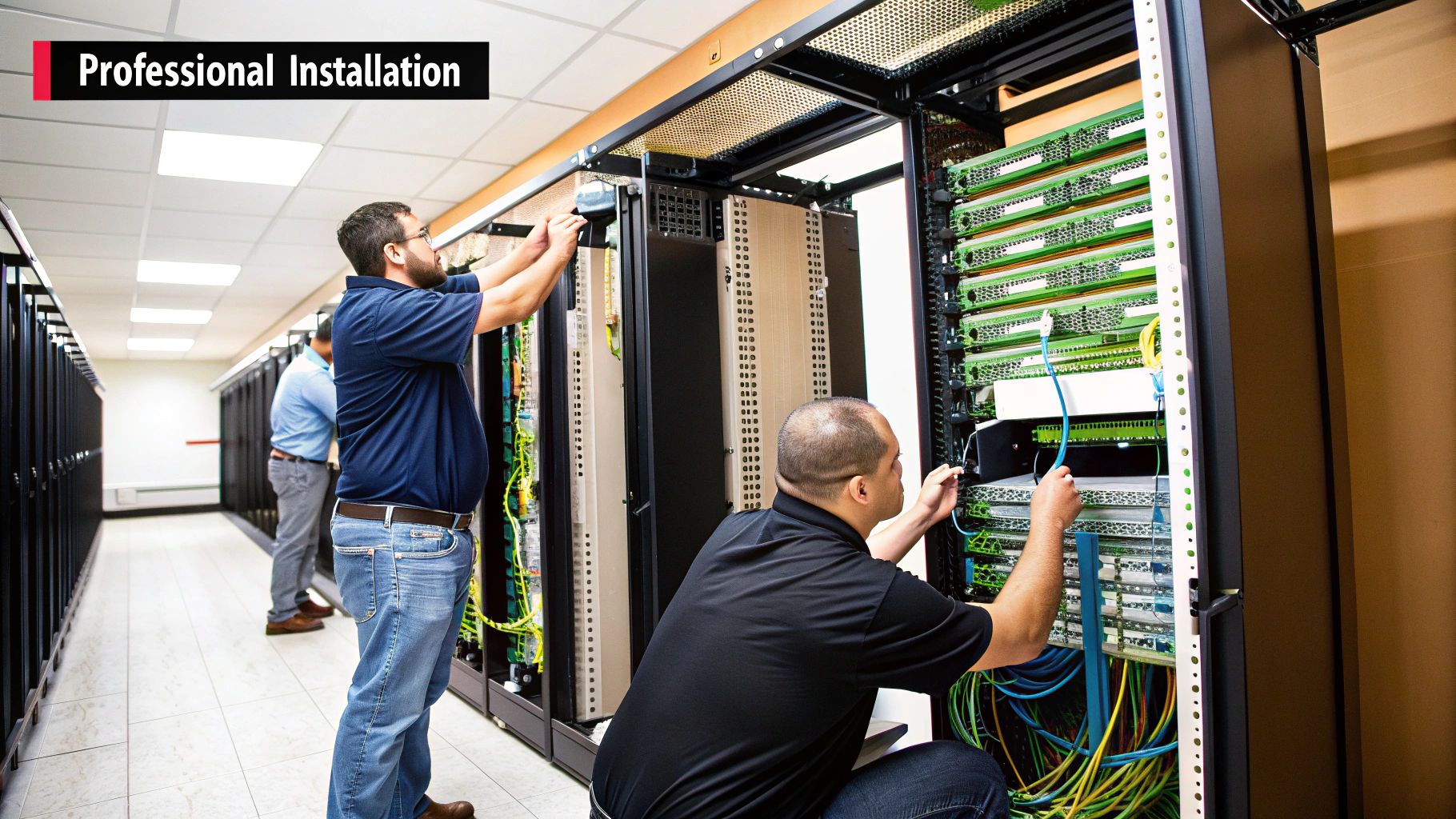
The success of your network infrastructure hinges almost entirely on the team you hire to install it. Picking the right partner for your structured cabling in Dubai is, without a doubt, the most critical decision you’ll make for the entire project. Get it right, and you’ll have a reliable, high-speed network for years. Get it wrong, and you’re signing up for chronic downtime, surprise costs, and a whole lot of frustration.
Think of it this way: you could hire a general handyman to frame your house, or you could bring in a master craftsman. Both will put up a structure, but only the expert ensures every joint is perfect and the foundation is strong enough to last a lifetime. This is exactly what you need for your network.
So, how do you find that expert in Dubai’s competitive market? Let’s break down what to look for.
H3: Look for Real Credentials and Certifications
First things first, you need to check a company’s credentials. In structured cabling, certifications aren’t just for show; they’re proof of competence and a commitment to quality. Any installer worth their salt will be happy to share their qualifications.
There are two main types you should ask about:
- Manufacturer Certifications: Leading brands like Siemon, CommScope, or Legrand have specific training programs for installers. A company certified by these brands can install their products to precise specifications. More importantly, this certification often unlocks extended warranties—sometimes up to 25 years—on both the products and their performance. An uncertified installer simply can’t offer you that peace of mind.
- Industry Certifications: Keep an eye out for credentials from organizations like BICSI (Building Industry Consulting Service International). A BICSI-certified technician has proven they understand the global best practices for network design, installation, and project management. It shows they’ve invested in their team’s education and are serious about their craft.
H3: Dig Into Their Experience and Past Projects
Not all cabling jobs are created equal. Wiring a new office tower from scratch is a world away from retrofitting a system in a busy, 24/7 hotel or warehouse. You need a partner who has successfully navigated projects just like yours.
Don’t be shy about asking for their portfolio. Ask for case studies that match your industry and the scale of your project. If you’re in hospitality, see their work in other hotels. If you’re in finance, ask about their experience in high-security data centers. This confirms they understand the unique challenges your environment presents.
A great way to vet a company is to ask for client references. A confident, capable provider will have a list of satisfied customers ready to vouch for them. Speaking directly to a past client is one of the best ways to gauge professionalism, communication, and whether they deliver on their promises.
Vendor Evaluation Checklist
Choosing the right provider can feel overwhelming, but a structured approach makes it manageable. Use this checklist to compare potential partners and ensure you’re asking the right questions.
| Evaluation Criteria | What to Look For | Why It Matters |
|---|---|---|
| Certifications | Ask for proof of manufacturer (e.g., Siemon, CommScope) and industry (e.g., BICSI) certifications. | This validates their technical skills and is often required for extended 25-year product and performance warranties. |
| Relevant Experience | Request case studies or examples of projects similar to yours in scale, industry, and complexity. | Proves they understand the specific challenges of your environment (e.g., hospital, data center, high-rise office). |
| Client References | Ask to speak with 2-3 recent clients who had similar projects. | Direct feedback on their reliability, communication, and ability to meet deadlines is invaluable. |
| Project Management | Inquire about their process for planning, scheduling, and minimizing business disruption. | A clear plan shows professionalism and respect for your operations. |
| Documentation Standards | Confirm they provide detailed “as-built” documents, including floor plans, port maps, and test results for every cable. | This documentation is essential for future maintenance, troubleshooting, and network changes. |
| Warranty & Support | Understand their workmanship warranty and process for post-installation support (MACs – moves, adds, changes). | A strong warranty and clear support plan show they stand behind their work long-term. |
By working through this checklist, you can move beyond a simple price comparison and evaluate each company on the factors that truly contribute to a successful, long-lasting network infrastructure.
H3: Understand Their Process from Start to Finish
A top-tier cabling company does more than just run wires; they manage the entire project and support their work long after they’ve packed up their tools. Before you sign anything, make sure you’re clear on their process and what happens after the job is done.
Here are a few key questions to ask:
- Project Plan: How will they manage the installation to keep disruptions to a minimum?
- Final Documentation: What will they hand over at the end? You should expect detailed floor plans, port maps, and certified test results for every single cable.
- Workmanship Warranty: What kind of guarantee do they offer on their labor, separate from the manufacturer’s warranty?
- Ongoing Support: What’s the process for future needs, like adding a new desk or troubleshooting an issue?
Ultimately, choosing the right structured cabling Dubai company is about finding a long-term technology partner, not just a contractor for a one-off job. By carefully vetting their skills, experience, and processes, you can find an expert who will build a network foundation that truly empowers your business.
Understanding Structured Cabling Project Costs
Figuring out a realistic budget for a structured cabling project in Dubai is about more than just a simple ‘price per port’. Frankly, that number can be deceiving. The real cost is a mix of the materials used, the labor involved, and the specific challenges of your workspace. Getting a handle on these factors is the key to truly understanding a quote and making an investment that pays off.
It’s a bit like getting a custom suit tailored. The final price isn’t just about the fabric; it’s about the quality of that fabric, the complexity of the cut, and the skill of the tailor. In the same way, your network’s price tag reflects the quality of its parts and the expertise required to put it all together perfectly.
Key Cost Drivers in a Cabling Project
The final number on your estimate comes from several things that all work together. Each one is important, and a change in one area can easily affect the total budget. A good installer will walk you through these, but it’s smart to understand them yourself.
Here are the main things that will determine the cost of your structured cabling Dubai project:
- Cable and Component Quality: This is your biggest material expense. Top-tier Cat 6A cabling, for instance, costs more upfront than standard Cat 6. Fiber optic cable is another step up in investment. What you choose really comes down to the speed and data you need now—and what you think you’ll need in the future.
- Installation Environment Complexity: Is this a brand-new building with open walls where running cables is easy? Or are you trying to upgrade a busy, working office? Navigating around existing furniture, live systems, and your team takes more time, careful planning, and specific skills, which naturally pushes up the labor cost.
- Total Number of Drops: The sheer quantity of network points, often called “drops,” is a huge factor. Every single drop means running a cable from your server room to a desk, plus the cost of the wall plate, keystone jack, and the port on the patch panel.
- Local Labour Rates: The experience and certifications of the technicians matter. When you pay for a team of certified professionals, you’re buying peace of mind. They know how to meet TIA standards and local Dubai regulations, which saves you from the headache and expense of having to fix a bad job later.
The Long-Term Value of Quality
It’s always tempting to find ways to shave down the initial cost. You might consider using cheaper, non-certified cables or hiring a less-experienced installer. It feels like you’re saving money, but this approach almost always backfires, leading to much bigger costs down the road.
A poorly installed network is a ticking time bomb for your business operations. The “savings” from a cheap installation are quickly erased by the costs of frequent downtime, endless troubleshooting, and the eventual need for a complete replacement.
Think about what really happens when your network fails. Your team can’t get to critical files, your VoIP phones go dead, or your payment systems disconnect. The financial hit is instant and often massive.
Putting your money into quality parts and a certified installation from a reputable structured cabling Dubai company is an investment in your business’s stability. You’re not just building a network for next year; you’re building a reliable digital foundation that will support your growth for the next decade. This mindset gives you a solid way to evaluate quotes and ensures your investment truly delivers.
Of course, here is the rewritten section with a more human, expert tone.
Your Cabling Questions, Answered
If you’re a business owner or IT manager, you probably have some practical questions about what a structured cabling Dubai project really involves. Let’s cut through the jargon and get straight to the real-world answers for the most common things we get asked.
What Is the Main Difference Between Structured and Regular Cabling?
Think of “regular” cabling like a tangled mess of extension cords daisy-chained together under a desk. It might work for a single PC, but it’s a recipe for disaster as soon as you add more devices. This point-to-point approach is the number one cause of network chaos, creating a system that’s confusing, unreliable, and a nightmare to manage.
Structured cabling, on the other hand, is a thoughtfully designed and organized system. Imagine a central telephone switchboard, but for your data. Everything runs back to a main patch panel, with every cable and connection point neatly organized and labeled. This approach makes your entire network dependable, easy to troubleshoot, and ready to grow with your business.
Can Structured Cabling Power Devices Like Cameras and Phones?
Yes, absolutely. This is one of the biggest advantages of a modern system. Cables like Cat 6 and Cat 6A are built to handle Power over Ethernet (PoE), a brilliant technology that sends both data and electrical power through a single network cable.
It completely simplifies how you set up all sorts of essential equipment, including:
- VoIP business phones
- Wireless Access Points (WAPs) for your Wi-Fi
- IP security cameras
- Smart lighting and other modern IoT devices
By using PoE, you eliminate the need for a separate power outlet at every device. This means less cable clutter, cleaner installations, and lower costs. It’s a smarter way to manage your network’s power and data from one central location.
How Long Does a Typical Office Installation Take?
This really comes down to the size and complexity of your office. For a smaller space with, say, 10-20 network points, we could be in and out in just a few days. But for a large, multi-story office in a Dubai skyscraper, the project could easily span several weeks.
One of the biggest factors is the state of the building. Installing cables in a new construction site with open walls is much faster. Working in a finished, operating office—what we call a retrofit—is more intricate. Our technicians have to be careful to work around your team and existing structures, which takes more planning to keep disruptions to a minimum.
Your network is the foundation your business runs on. To get it right from the start, you need to work with people who know what they’re doing. For professional design, installation, and support for your structured cabling in Dubai, get in touch with OMX Solutions L.L.C. today.
Find out how we can build a rock-solid, future-ready network for your business at https://omxsolutions-com-885994.hostingersite.com.
Article created using Outrank